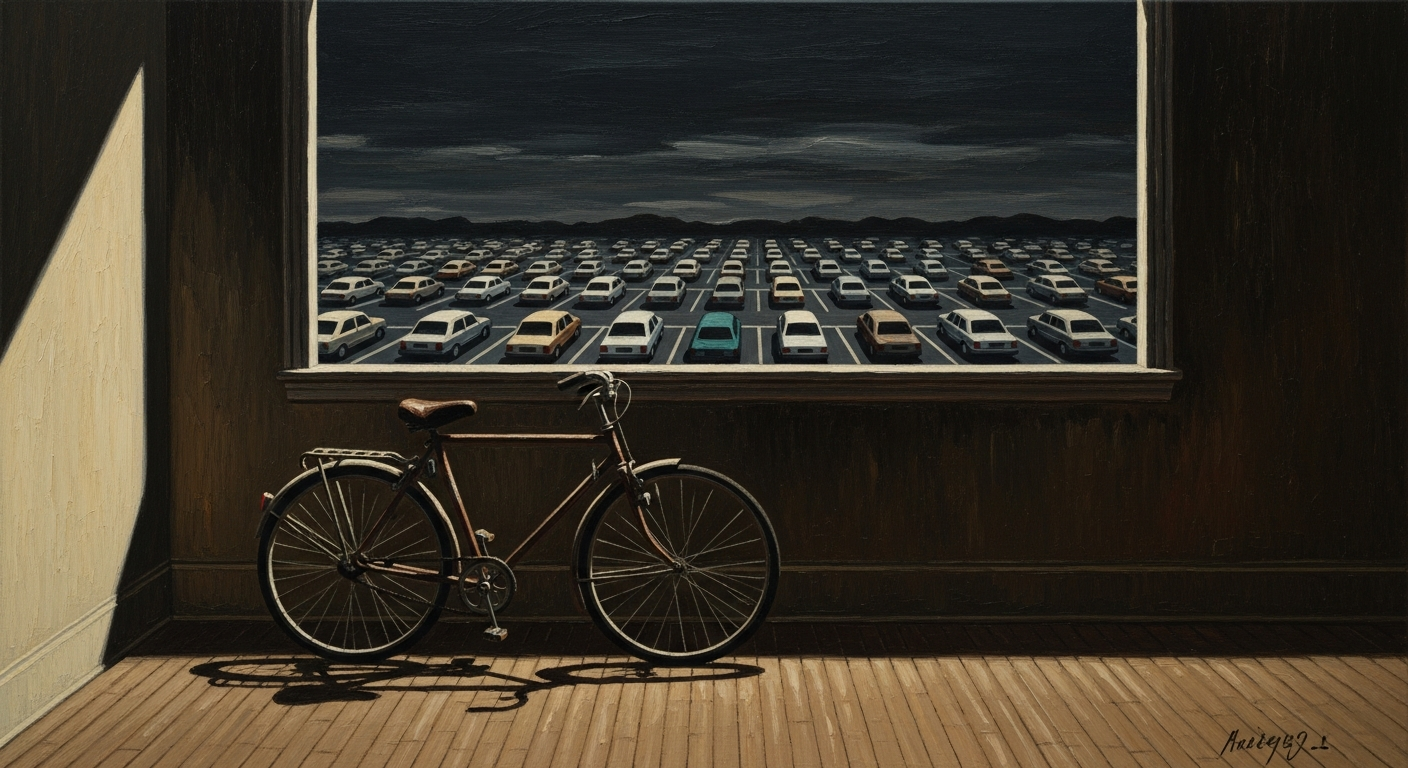
Steve's prompt: "blog post about how steve jobs quote about the pc being the bicycle of the mind. praise him for the clever turn of phrase. then talk about how the networked computer coupled with ai is the self-driving car of the mind and you go to sleep in the back or you control a whole fleet of cars. will they crash."
The Metaphor That Lasted 45 Years
In 1980, Steve Jobs said the personal computer was "a bicycle for the mind."
He'd read a study comparing the locomotion efficiency of various species. A condor topped the list. Humans ranked somewhere in the middle. But a human on a bicycle blew everything away. The bicycle didn't replace human locomotion. It amplified it. You still pedaled. You still steered. You still chose the route. The bicycle just made every unit of human effort go further.
That's a perfect metaphor. Not good. Perfect. And Jobs knew it, which is why he repeated it for the rest of his life. It worked because it captured something precise about what the personal computer actually did. The PC didn't think for you. It didn't make decisions for you. It took your effort and multiplied it. Spreadsheets let you organize numbers faster. Word processors let you write and revise faster. Databases let you find things faster. Every application was a gear ratio. You pedaled. The computer made the pedaling count.
For 45 years, that metaphor held. The computer was a bicycle. The human was the rider. The rider chose the destination, chose the route, did the work. The bicycle was a tool. The most powerful tool in history, but a tool. It went where you pointed it.
The Bicycle Got an Engine
The internet changed the bicycle, but it was still recognizable. The networked computer was a bicycle that could ride on any road in the world, instantly. You could reach any library, any marketplace, any person. The terrain expanded from your desk to the entire planet. But you still pedaled. You still decided where to go, what to read, who to talk to. Google was a map. Amazon was a store. Email was a postal service. The metaphors were all still about human agency amplified by machines.
Social media bent the metaphor a little. The algorithm started suggesting where to ride. You still held the handlebars, but the road tilted. The bike went downhill toward content that kept you pedaling longer. Attention economics. Engagement optimization. The bicycle was still a bicycle, but someone had started adjusting the gradient of the hill without telling you.
AI broke the metaphor entirely.
The Self-Driving Car
A bicycle requires a rider. A self-driving car does not.
When you open ChatGPT and say "write me a business plan," you are not pedaling. You are typing a destination into a navigation system and climbing into the back seat. The AI chooses the route. The AI decides which turns to take, which facts to include, which framework to use, which cognitive map to draw. You arrive at the destination and evaluate the result. But you did not do the thinking. The car drove itself.
Jobs's bicycle made every unit of human effort go further. AI eliminates the effort. That's a different thing. A bicycle rider who stops pedaling stops moving. A passenger in a self-driving car who falls asleep in the back seat still arrives.
And that's the generous version. The realistic version is worse.
Asleep in the Back Seat
When you paste AI output into an email without reading it carefully, you are asleep in the back seat. When you let AI summarize an article instead of reading it, you are asleep in the back seat. When you ask AI to explain something and accept the explanation without checking it, you are asleep in the back seat.
The car is driving. You trust the car. The car has a confident voice and a smooth ride and it usually gets you somewhere that looks like the right neighborhood. Sometimes it does. Sometimes it hallucinates a destination that doesn't exist and drops you there with full confidence. You wake up, look around, and have no idea how you got here or whether "here" is where you asked to go.
A bicycle rider who gets lost knows they're lost. They can see the road. They can retrace their route. A passenger who fell asleep in a self-driving car and wakes up in the wrong city has no route to retrace. They weren't watching. They don't know where the wrong turn happened. They don't even know the wrong turn happened.
That's the cognitive map problem, restated as transportation. The AI didn't just take a wrong turn on the right map. The AI is driving on a completely different map. And you can't tell, because you're asleep, because the whole point of a self-driving car is that you don't have to watch the road.
The Fleet
Now it gets interesting.
A bicycle is one rider, one bike. A self-driving car is one passenger, one car. But self-driving cars can be dispatched as a fleet.
Steve said "make this website." Claude built it. One car, one destination. Then Steve said "write ten blog posts." Ten cars, dispatched simultaneously, all driving to different destinations. Then Steve said "generate images for all of them." Another fleet. "Deploy everything." Another fleet. "Find people to reach out to." Another fleet. Each car operating autonomously, each one arriving at a result, none of them requiring Steve to steer.
Jobs's bicycle amplified one person's effort along one path. AI lets one person dispatch a fleet along a hundred paths. The multi-agent future that Altman talks about is a fleet management system. Your personal AI dispatches specialized AIs the way a logistics company dispatches trucks. Research agent goes here. Writing agent goes there. Image agent, deployment agent, outreach agent, analytics agent. All driving simultaneously. All reporting back to one person who typed one sentence and leaned back in the chair.
That's power that the bicycle metaphor cannot contain. A person on a bicycle is faster than a person on foot. A person commanding a fleet of self-driving vehicles is operating at a fundamentally different scale. The bicycle made you more efficient. The fleet makes you an operation.
Will They Crash?
Yes.
Self-driving cars crash. Ask Elon Musk, who has been promising fully autonomous vehicles since 2016 and has so far delivered a fleet of very expensive cars that occasionally drive themselves into fire trucks. "Full Self-Driving" has been "coming next year" for nine consecutive years. The man who can't get a car to reliably navigate a left turn now wants to build humanoid robots and put chips in your brain. This is the guy people trust with autonomous systems. He can't even autonomously run a social media platform without driving it into a ditch.
But the AI fleet doesn't need to work perfectly. It just needs to work well enough that people stop checking. And that threshold is a lot lower than "never crashes." That threshold is "crashes less often than I notice."
A fleet of AI agents operating simultaneously will produce errors. Hallucinations. Wrong turns. Broken cognitive maps that lead to confidently wrong conclusions. An agent negotiating with another agent based on a framework neither understands. An agent posting content that pollutes the noosphere because its optimization function doesn't include "be true" as a constraint.
When one bicycle crashes, one rider gets hurt. When one self-driving car crashes, one passenger gets hurt. When a fleet crashes, everything the fleet touched is affected. Every email it sent. Every post it published. Every decision it made on your behalf. The blast radius of a fleet failure is proportional to the fleet's reach.
And here's the part that connects back to removing the brakes. The company building the largest fleet (OpenAI) just disbanded the team responsible for mission alignment. The safety team was the quality control department for the fleet. The people checking whether the cars were driving correctly, whether they were going where they were supposed to go, whether the maps were accurate. That department was closed. The fleet is expanding. The quality control is shrinking.
Who Learned to Ride?
The thing about a bicycle is that you have to learn to ride it. You fall. You scrape your knees. You develop balance, coordination, judgment. The learning is physical and painful and it stays with you. A person who learned to ride a bicycle understands something about momentum, friction, and their own body that a person who never rode does not.
Nobody learns to ride a self-driving car. There is nothing to learn. You get in. You state your destination. You arrive. The skill that bicycle riders developed over years of practice, the ability to steer, to balance, to read the road, to recover from mistakes: none of that transfers. The fleet operator who has dispatched a thousand AI agents has not learned to think better. They have learned to delegate faster.
Jobs's metaphor honored the rider. The bicycle was great because the human was great. Human effort, amplified. Human judgment, extended. The computer didn't replace the human. It made the human more capable.
The self-driving car doesn't honor the passenger. The passenger is cargo. Valuable cargo, because the cargo decides the destination. But cargo nonetheless. The car does the driving. The car makes the micro-decisions. The car chooses the route. The passenger's only job is to say where they want to end up and to trust that the car will get them there.
Jobs would have hated this.
The Fork in the Road
Two futures.
In one, AI is a better bicycle. Humans still pedal, still steer, still learn. AI handles the mechanical parts. The boring calculations, the data retrieval, the formatting. The human does the thinking, the judging, the creating. The bicycle gets lighter, the gears get smoother, but the rider is always the one choosing where to go. This is the future the nuclear knowledge war demands: humans armed with AI, using it with skill and awareness.
In the other, AI is a fleet of self-driving cars. Humans state destinations and fall asleep. The fleet handles everything. The humans wake up at the destination, or in the wrong city, or in a ditch. They don't know how to ride anymore. They don't know the roads. They don't know how to read a map. They just know how to say where they want to go and trust that the machine will figure out the rest.
We are currently accelerating toward the second future. Every product announcement, every "just ask the AI" interface, every agent framework that operates without human oversight is another step toward a world where people don't ride bicycles anymore because the self-driving car is right there and it's so much easier.
Steve Jobs looked at a human and saw a condor on wheels. The most efficient mind-mover on Earth, amplified.
Sam Altman looks at a human and sees a passenger. Someone who needs to be driven somewhere. Faster, smoother, with less effort. The destination is the product. The ride doesn't matter. The rider doesn't matter. The fleet does.
One of these visions built the most valuable company in history. The other is trying to build something bigger.
The bicycle is still in the garage. You could still ride it. The question is whether anyone will bother, once the fleet is ready.
Sources & References
- Jobs, Steve. "Computers are like a bicycle for our minds." Interview, 1990.
- Wilson, S.S. "Bicycle Technology." Scientific American, March 1973. (The locomotion efficiency study Jobs referenced.)